What Is Answer Engine Optimization (AEO) for Small Sites

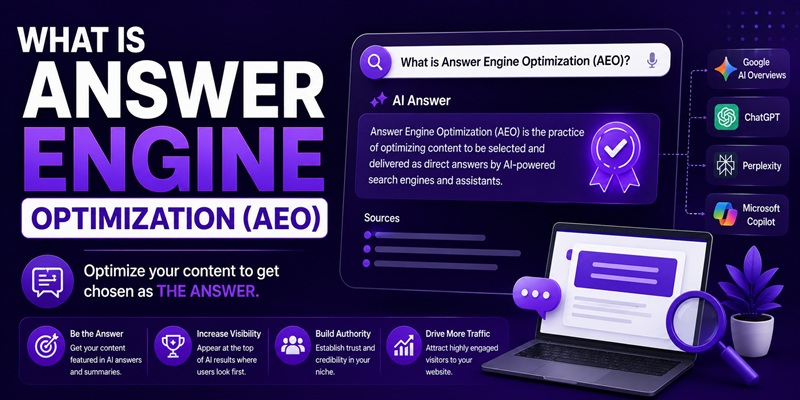
Answer Engine Optimization (AEO) is the practice of structuring your content so AI systems like ChatGPT, Perplexity, and Google’s AI Overviews can pull a clear answer out of it and cite your site as the source. Where classic SEO optimizes a page to rank in a list of results a person then clicks through, AEO optimizes a page to be the thing an AI system lifts out and quotes directly, sometimes without a click happening at all. For a small site, that difference isn’t philosophical. It comes down to writing answers a machine can extract cleanly instead of copy that only makes sense after three paragraphs of setup.
What Answer Engine Optimization Actually Means
An answer engine is any system that reads several sources, synthesizes them, and hands the user a single response instead of a ranked list of links. ChatGPT, Perplexity, Google’s AI Overviews and AI Mode, and voice assistants all work this way. Compare that to a classic search results page: ten blue links compete for the click, and the reader decides which one to open. An answer engine skips that step. It reads across multiple pages, picks the passages that answer the question best, and blends them into one response, sometimes naming its sources and sometimes not.
That’s the whole shift in one sentence: your job stops being “win the click” and starts being “be the passage worth quoting.” Everything else in this guide, and every spoke article this pillar links to, is a variation on that one idea applied to a specific part of your site.
What Actually Changed for a Site Owner: Extraction, Not Just Ranking
Search behavior is genuinely shifting toward more queries returning a synthesized answer instead of a plain list of links, a pattern that’s been visible across major search platforms for the past couple of years. What changes for you as a publisher isn’t the mechanics of crawling and indexing, which still work the way they always have. What changes is what happens after a page gets crawled: an AI system chunks the page into passages and judges each one on whether it answers the query well enough to quote, on its own, without the rest of the page for context.
That rewards a different kind of writing. A page that builds slowly to its point over five paragraphs might rank fine and still never get quoted, because no single paragraph stands alone as a complete answer. A page with a tight, self-contained answer near the top gives the system something clean to lift.
Picture two posts answering the same question, “what does a lifetime deal mean legally.” One opens with a paragraph about the writer’s history with software deals before ever defining the term. The other opens with a plain, two-sentence definition, then goes into the history for readers who want it. Both might rank. Only the second gives an answer engine a passage it can lift without editing it down first. That’s the practical test worth running on your own posts: could a stranger read only your first two sentences and walk away with the actual answer?
What AEO Shares With Good SEO
AEO is not a separate discipline you bolt on top of SEO. Most of what makes a page rankable also makes it extractable: clean crawlable HTML, accurate headings, a page that loads without a fight, content that’s actually correct, and enough topical depth that the page reads as an authority on its subject rather than a thin summary. Several of the write-ups I reviewed while researching this piece note that AI Overviews and similar tools draw a meaningful share of their cited sources from pages that are already ranking well organically. That tracks: an answer engine still has to find your page before it can quote it, and the same signals that help Google rank a page help an AI system decide it’s worth trusting.
Internal linking, consistent site structure, and honest, specific writing all carry over unchanged too. None of that work gets thrown out. If your SEO fundamentals are already solid, you’re not starting from zero. You’re adding a layer, not replacing the foundation.
Where AEO Genuinely Diverges From SEO
The divergence shows up in what you’re optimizing for at the sentence level, not the page level.
| Focus | Traditional SEO | AEO |
|---|---|---|
| Primary goal | Rank high enough to earn the click | Get extracted and cited, whether or not a click follows |
| Unit that matters most | The page as a whole | The specific paragraph or sentence containing the answer |
| Structure’s job | Helps crawlers and skimming readers scan the page | Helps a system isolate one clean, quotable passage |
| Trust signal | Backlinks and domain authority, built over time | Clear sourcing, consistent entity details, a named author |
| What you compete against | Other ranked pages for the same query | Other passages an AI system could quote instead of yours |
None of this makes backlinks or domain authority irrelevant. It means a second, more granular layer of competition now sits on top of the old one: even a page that ranks respectably can lose the citation to a competitor’s page that simply states the answer more cleanly.
The Small-Site Angle: What You Can Actually Control
Here’s the part most AEO explainers skip, because most of them are written for teams with a content-ops budget: what can one person, running a site with a few dozen posts, realistically do?
Domain authority takes years and, usually, a marketing budget you don’t have. You can’t shortcut that, and I wouldn’t pretend otherwise. But extractability is almost entirely under your control, and it costs editing time, not budget. That means: opening each important post with a direct answer in the first couple of sentences, structuring your H2s so they match the actual questions a reader would ask, keeping paragraphs short enough to stand alone, and writing definitions as clean, complete sentences instead of burying them in a longer explanation. It also means basic housekeeping most small sites skip: keeping your author bio, name, and site details consistent everywhere they appear, and filling in schema fields accurately rather than leaving them blank or copy-pasted from a template.
What that looks like on an actual post: take a paragraph that currently reads as three sentences of throat-clearing before the point, and rewrite it as one sentence that states the answer, followed by the supporting detail. Nothing about the underlying research or the word count needs to change, just the order the reader (and the system parsing the page) meets the information in.
None of that requires a team or a platform subscription. It requires going back through what you’ve already written and editing it like an answer engine is going to read it, because increasingly, one is. The full checklist version of this, with a step you can run against any post you already have, lives at AEO checklist for WordPress. The specific mechanics of that opening paragraph are covered in how to write an answer-first opening.
What You Can’t Control, and Why Nobody Can Promise You a Citation
I’ll say this as plainly as the rest of this site says it: nobody, including me, can promise you a citation from ChatGPT, Perplexity, or Google’s AI Overviews. Which passages get quoted, on which query, on which day, is decided by retrieval and ranking logic those companies don’t publish and can change without telling anyone. A structure that gets a page cited this month can stop working next month for reasons that have nothing to do with anything you did wrong.
That’s not a reason to skip structure work. Extractable, clearly answered content is worth doing on its own terms, for human readers first, whether or not any specific citation follows. It’s a reason to be honest that “do these five things and get cited” is a promise nobody selling AEO advice should be making, including a guide like this one. If you want a concrete way to check whether any of this is actually happening on your own site rather than guessing, that’s a separate, practical question, and it’s covered in how to check if AI is citing your site.
A First Pass: What to Check on Your Own Site This Week
You don’t need to touch your whole site at once. I’d start narrow: pick three to five of your most important posts, the ones that answer a question your audience actually asks. For each one, check whether the first two or three sentences under the headline actually answer that question, or whether they warm up first. Check whether your H2s read like the questions a reader (or an AI system parsing the page) would actually ask, rather than vague labels. Check whether any comparison or definition buried in a paragraph would read better as a short list or a table.
Give each post you check no more than ten minutes at this stage. You’re not rewriting anything yet, just marking which posts have a clean opening answer and which ones bury it. That short audit alone usually tells you where to spend actual editing time first, and it’s a habit worth repeating every few months rather than a one-time project.
This overlaps directly with good SEO housekeeping. If your site runs Rank Math or a similar plugin, the same schema fields that plugin exposes for search results also matter here; the Rank Math vs Yoast comparison on this site covers how the two handle that differently if you’re deciding between them. And if any of this work eventually points you toward a paid tool to help manage it at scale, run it through the same evaluation habits covered in the lifetime deal evaluation framework before buying anything, whether it’s marketed as an “AEO tool” or not. For the terminology question this piece deliberately doesn’t resolve here (whether AEO, GEO, and plain SEO are really three different jobs, or three names for overlapping work), see AEO vs SEO.
That’s the whole starting point: three to five posts, an honest look at the opening paragraph and the headings, and a decision about what’s worth fixing first. Everything past that first pass is mechanics: schema fields, crawler behavior, heading structure, measurement, and that’s what the rest of this cluster covers in depth, one piece at a time.
FAQ
Is AEO a replacement for SEO?
No. Most of what makes a page rank well (accurate content, clean structure, technical health) also makes it easier for an AI system to extract and trust. AEO adds a layer focused on making individual passages quotable; it doesn’t replace SEO fundamentals.
Do I need to rewrite my whole site for AEO?
No, and I wouldn’t recommend trying. Start with the handful of posts that answer questions your audience actually asks, apply the structural changes there, and treat the rest as ongoing maintenance rather than a one-time overhaul.
Can I guarantee an AI system will cite my content?
No. Citation decisions are made by systems whose retrieval and ranking logic isn’t published and can change at any time. Anyone promising guaranteed citations is promising something outside a publisher’s control.
Does AEO apply to a site with only a handful of posts?
Yes. Extractability is a writing and structure habit, not a function of how many posts you have. A ten-post site can write an answer-first opening paragraph just as well as a five-hundred-post site can.
What’s the fastest thing to check first?
Open your three most important posts and read the first two sentences under the headline. If they don’t answer the reader’s core question plainly, that’s the first fix, before anything involving schema or technical structure.
