Lifetime Deal Red Flags: A SaaS Buyer’s Checklist

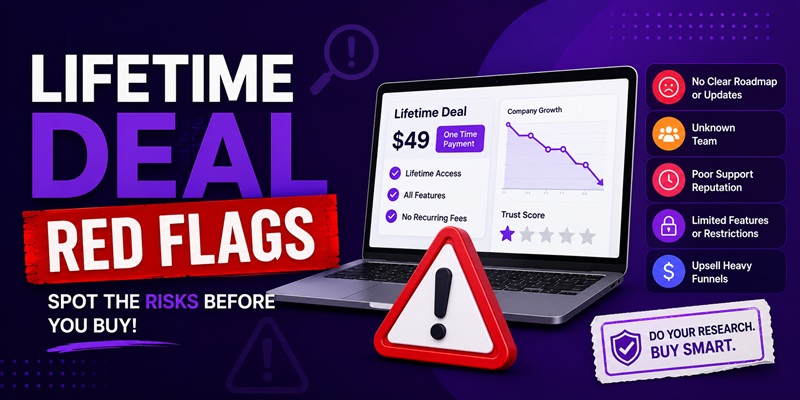
The clearest lifetime deal red flags in SaaS are these: no product updates or changelog movement in 60 or more days, pricing math that makes no sense (a tool billed high every month sold cheap for life), reviews that are all five stars with no specific criticism, missing or recently removed data export, a deal that launched within months of the product itself, a founder or company you cannot verify, and integration access that has quietly narrowed since launch. For an SEO or marketing tool, add one more that generic checklists skip: accuracy claims nobody has actually tested. Any single flag is a reason to slow down. Two or more, and you are probably looking at a tool that will not be here in three years.
A lifetime deal is a one-time bet. You pay once, and after the marketplace refund window closes you own whatever the tool becomes, including nothing. That asymmetry is the whole reason a screening checklist matters more here than for a monthly subscription you can cancel. This page is the practical companion to the fuller SEO tool lifetime deal framework. The framework covers how to decide whether a deal is worth it at all; this one is the fast red-flag pass you run before you spend.
How to read this checklist
Not every flag carries the same weight. Some are hard stops. Others are yellow lights that only matter when you see two or three together. The table below is the whole decision in one view: the flag, what it usually predicts, and the exact thing to check so you are not guessing.
| Red flag | What it usually predicts | What to check | Weight |
|---|---|---|---|
| No changelog or roadmap movement in 60+ days | Development has stalled; team may be gone | The public changelog, blog, or “what’s new” page and its dates | Hard stop |
| Pricing math that does not work | Cash-grab pricing, short runway | Compare the claimed monthly price to the one-time price | Caution |
| All five-star reviews, zero specifics | Curated or incentivized reviews | Read the three most critical reviews you can find | Caution |
| Data export missing or recently removed | Lock-in; you cannot leave with your work | Try to find the export button or docs before buying | Hard stop |
| Deal launched within months of the product | Selling lifetime access to fund a v1 | The product’s launch date versus the deal date | Caution |
| Founder or company cannot be verified | Nobody to reach when it breaks | A real name, a real support channel, a reply in the deal comments | Hard stop |
| API or integrations quietly narrowing | Costs being cut; features being pulled | The integrations page against older docs or reviews | Caution |
| Accuracy claims nobody has tested (SEO tools) | A confidently wrong tool you act on | Whether anyone has checked the data against a known source | Caution |
The rest of this page explains each one, then covers the quiet signs that sound minor but tend to predict a dead tool, the part most checklists leave out.
Sign 1: No changelog or roadmap movement in 60+ days
This is the single most reliable signal, and it is public. A tool under active development ships things: bug fixes, small features, a “what’s new” note. When the changelog goes quiet for two months or more, the usual reason is that the people who were building it have moved on.
What to check: find the changelog, release notes, or product blog and read the dates, not the promises. A roadmap page full of “coming soon” with no shipped dates behind it counts as silence, not activity. One caveat: solo makers sometimes ship in bursts, so pair a quiet changelog with the other flags rather than reading it alone.
Sign 2: The pricing math does not work
Lifetime deals trade a permanent obligation for one lump of cash today. That is exactly what a company does when it needs cash today. So the math is a signal. If a tool advertises a high monthly price but sells lifetime access for a fraction of a single year, one of two things is true: the monthly price was inflated to make the deal look better, or the company needs the cash badly enough to sell its own future cheaply.
What to check: divide the lifetime price by the claimed monthly price. If it works out to only a few months of subscription, ask why they would give away everything after that. Neither answer is good for you.
Sign 3: Reviews are all five stars with no specific criticism
Real software annoys real users. A review page with nothing but glowing five-star ratings and no concrete complaint has usually been curated, incentivized, or posted during a launch window before anyone hit the edge cases. The useful reviews are the three-star ones that say exactly what broke.
What to check: sort for the most critical reviews and read them first. If they do not exist, or every one-star review is met with a defensive vendor reply, treat the rating as marketing, not evidence.
Sign 4: Data export is missing, limited, or was recently removed
For an SEO tool this is not a convenience feature. Your keyword lists, your audits, your tracked rankings, that is your work, and a tool that will not let you export it has locked you in. Worse is the tool that used to offer export and quietly removed it, which almost always means someone is cutting costs.
What to check: before you buy, confirm the export exists and covers your actual data, not just a token CSV. If reviews from a year ago mention an export the current tool no longer has, that is a tool contracting, not growing.
Sign 5: The deal launched within months of the product
There is a difference between an established tool running a promotion and a brand-new product selling lifetime access to fund its own first version. The second one is asking you to prepay for a company that has not proven it can survive.
What to check: compare the product’s launch date to the deal’s launch date. A tool that has been running for a few years and offers a lifetime deal to boost cash is a different risk than one selling lifetime seats in month two. Early is not automatically bad, but it belongs in the math.
Sign 6: The vendor identity cannot be verified
A lifetime deal with no one to contact when things break is worthless. If the person behind the product is visible, posting updates, and answering hard questions in the deal comments, that is a green flag. An invisible founder, a company with no real name, no history, and a support channel that is only a contact form, is a red one.
What to check: look for a real named human, a support channel that gets replies, and evidence the founder is actually engaging. The deal comment threads are the best tell here, which brings us to the quiet signs below.
Sign 7: API or integrations have quietly narrowed
Tools rarely announce that they are cutting features. What you see instead is an integrations page that used to list ten connections and now lists four, or an API tier that got restricted after the deal sold. Narrowing scope after a big cash injection usually means the runway got shorter, not longer.
What to check: compare the current integrations or API docs against older reviews and cached pages. Growth adds connections. Trouble removes them.
The category flag: accuracy nobody has tested (SEO and marketing tools)
Here is the one that generic SaaS checklists miss, because it only bites on data tools. A project manager either moves the card or it does not. But a rank tracker, a keyword-volume database, or an “AI content” generator can be confidently, invisibly wrong, and you will act on that wrong output before you ever notice.
A tool that is confidently wrong is worse than no tool, because you build decisions on it. So for any SEO or marketing tool, the lifetime deal question is not only “will this company survive,” it is “is the data even right.” Vague model-sourcing claims (“powered by advanced AI”), a keyword database with no stated size or source, rank-tracking accuracy nobody has checked against a manual search, these are red flags specific to this category.
What to check: look for anyone who has compared the tool’s output to a known-good source. If nobody has, and the vendor will not say where their data comes from, you are being asked to trust a number you cannot verify. That is a bet, not a purchase.
The quiet flags most checklists skip
The signs above are loud. These are the ones that sound minor and get waved away, yet in practice they predict a dead tool more often than the obvious stuff.
- The founder goes quiet in the deal comments. Early in a launch the maker answers everything. Watch what happens when someone posts a hard bug or asks about the roadmap and gets nothing back. A founder who stops replying to their own paying customers is usually a founder who has mentally checked out of the product.
- The roadmap is all adjectives and no dates. “Powerful new features coming soon” is not a roadmap. A real one has items with rough timeframes and a track record of shipping them. When every future feature is perpetually “coming soon” and none of last quarter’s promises shipped, the roadmap is a marketing page.
- Support answers get slower over the deal’s life. A reply time that drifts from hours to days to silence over a few months is a team shrinking in real time. It is visible if you read the support forum in date order.
- The tool is sold only on its own site, never on an established marketplace. Selling exclusively off-platform skips the buyer protections and the refund mechanics a marketplace enforces. It is not proof of a scam, but it removes your safety net, which matters more when the other flags are present.
- A “lifetime deal” for a premium tool that has no official lifetime plan. Some deals promise lifetime access to a well-known paid platform that has publicly stated it does not sell lifetime access. That is not a bargain; it is almost always a shared-account or reseller scheme that gets shut down, taking your access with it. If the brand behind the tool does not officially offer a lifetime plan, be very suspicious of anyone who claims to.
None of these is a headline. Together they describe a tool coasting toward the exit, and they show up weeks before the changelog officially goes dark.
What to do if you spot a flag after you already bought
Sometimes you find the flag after the purchase. The move then is speed. Most marketplaces run a fixed refund window, and once it closes your one-time payment is final regardless of what the tool becomes. If a red flag surfaces and you are still inside that window, act before it shuts. The specifics of how that process works, what qualifies, and how long you have are covered in the AppSumo refund policy guide.
If the window has already closed, salvage what you can: export your data now while the tool still runs, and document what you have in case access ends. This is also why cloaking and managing your affiliate or outbound links through a tool you control matters, so a dead vendor does not take your link structure down with it, a point covered in the Pretty Links review.
Honest limits of this checklist
This is a screen, not a guarantee. A tool can pass every check and still fold when a founder burns out or a market shifts. Nobody controls those, and anyone who promises they can is selling something. What a checklist does is shift the odds: it filters out the deals showing the documented warning patterns, so the bets you do make are the better-informed ones. It cannot tell you whether a given tool fits your specific stack, your budget, or the one workflow you actually need it for. That judgment stays yours.
FAQ
What is the single biggest red flag in a SaaS lifetime deal?
A stalled changelog. If the tool has not shipped an update or moved its roadmap in 60 or more days, active development has likely stopped, and everything else you are evaluating is built on a product that is no longer being maintained.
Are lifetime deals for SEO tools riskier than for other software?
They carry one extra risk: data accuracy. A rank tracker or keyword tool can be wrong in ways you cannot see, and you act on the output before you notice. Beyond the standard survival checks, an SEO tool deal needs the question “is the data even correct,” which most general checklists never ask.
Is a brand-new tool selling a lifetime deal always a scam?
No, but it is a different risk. An established tool running a promotion is safer than a month-old product selling lifetime seats to fund its first version. Early is not automatically bad; it just belongs in your math alongside the other flags.
How many red flags should make me walk away?
Treat the hard-stop items (no updates, no data export, unverifiable vendor) as single-flag deal-breakers. The caution flags are cumulative: two or three together is enough to walk, even if each one alone felt minor.
Can I get my money back if the tool shuts down after the refund window?
Usually not from the marketplace once the window closes, which is why speed matters if you spot a flag early. If it has already closed, focus on exporting your data while the tool still works rather than expecting a refund.
