Lifetime Deal vs Subscription: The Break-Even Math

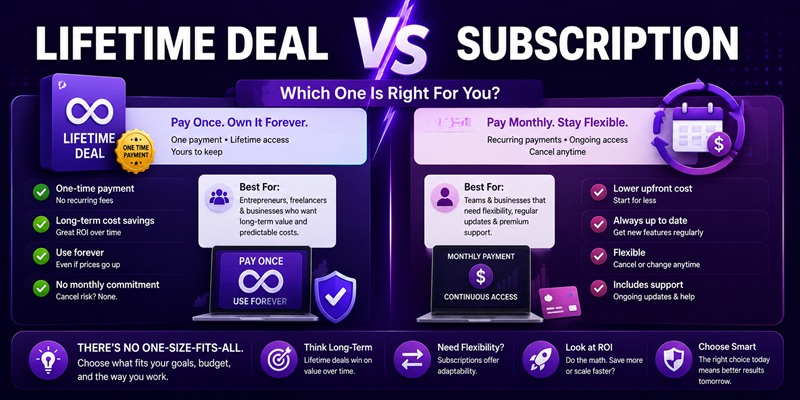
The formula is simple: break-even in months = lifetime deal price ÷ the monthly subscription it replaces. If a $79 lifetime deal replaces a tool you’d otherwise pay $15 a month for, you break even in a little over five months. Every month you keep using it after that is money the subscription would have cost you. The formula never changes. What changes the answer is what you plug into it, and that is where most lifetime-deal comparisons quietly go wrong.
This is not a savings promise. It’s arithmetic you can run yourself on any deal, in under a minute, before you decide whether the “lifetime” part is even worth thinking about.
Why price isn’t the number that actually matters
Every lifetime-deal comparison starts with the sticker price, and that’s the wrong first input. The number that decides whether the math works is usage, not price: how many months you would genuinely keep paying for the subscription if the lifetime deal did not exist.
Two readers can look at the identical $99 deal replacing a $20/month tool and get two different right answers. One of them uses the tool every week and would happily keep paying $20 a month for years. For that person, breaking even in five months is close to a guaranteed win. The other person tried the subscription for six weeks, used it twice, and canceled. For that person, the “$20/month” in the formula was never real; the honest comparison is against zero, and no lifetime price breaks even against a subscription you were about to cancel anyway.
So before running any calculation, answer this first: would I still be paying for this subscription in twelve months if the lifetime deal didn’t exist? If the honest answer is no, the break-even math is answering a question you don’t have.
The worked example, step by step
Here is the full calculation, done in the open, with numbers chosen only to make the arithmetic clear rather than to represent any real product’s pricing.
| Step | What you do | Illustrative numbers |
|---|---|---|
| 1 | Find the monthly price of the subscription you’d otherwise keep paying | $20/month |
| 2 | Find the one-time lifetime deal price | $99 |
| 3 | Divide: lifetime price ÷ monthly price | 99 ÷ 20 = 4.95 months |
| 4 | Round up to a whole month, since partial months don’t exist in billing | 5 months |
| 5 | Compare to how long you’d realistically use the tool | If you’d use it 12+ months, you’re ahead by month 6 onward |
Five months is a fast break-even by most standards discussed across lifetime-deal blogs, several of which put anything under eight months in the “strong deal” range for a tool used regularly. That framing is reasonable as a rule of thumb, but it is a rule of thumb, not a guarantee tied to this specific deal, and it says nothing about whether the company selling the deal will still be running the product in month six.
If the deal is stackable, the math changes again: buying two codes to unlock a higher tier means your break-even is against the monthly price of that higher tier, not the base one. Work that comparison separately rather than assuming the discount scales linearly. Tier stacking is covered in full here.
What the formula ignores: the survival question
A break-even calculation answers “when do I stop losing money if the tool keeps working.” It says nothing about whether the tool will keep working. This is the gap every lifetime-deal calculator I checked leaves open, and it’s the one that actually matters for a one-time, non-recurring purchase.
Here’s the asymmetry that makes this important. A subscription that goes bad costs you one more month before you cancel. A lifetime deal that goes bad, where the vendor stalls, gets acquired and sunset, or simply stops shipping updates, costs you the entire lifetime price with nothing left to cancel. The break-even math treats both purchases as equally safe once the arithmetic clears. They are not. A five-month break-even on a tool from a vendor with no changelog activity and no verifiable founder is a worse bet than an eight-month break-even on a tool that’s been shipping updates for three years.
I’m not going to quote a specific failure-rate percentage for lifetime-deal software here. Different sites throw around different numbers, and I can’t verify any of them well enough to put a figure in front of you and call it fact. What I can say plainly: a meaningful share of these tools do not last, so treat the break-even number as one half of the decision, not the whole thing. The other half, checking whether the company is actually a going concern, is covered in the vendor due-diligence checklist and the fuller lifetime deal framework.
When a short break-even still isn’t a good buy
A fast break-even feels like a green light, but three situations turn a good number into a bad purchase anyway.
- You wouldn’t have paid for the subscription at all. If you were on the free tier, or hadn’t decided to subscribe yet, the “savings” in the formula are against a cost you were never going to pay. You’re not saving $180 a year; you’re spending $99 you weren’t going to spend.
- The deal replaces a tool you use rarely. Break-even measures cost, not value. A five-month break-even on a tool you touch twice a year is still money sitting unused, even though the arithmetic looks good on paper.
- The company shows the red flags covered separately. A stalled changelog, an unreachable founder, or reviews with no specific criticism turn a fast break-even into a fast way to lose the entire amount, not just a slower one. Run the red-flags checklist alongside the math, not after it.
The reusable worksheet
Screenshot this. It’s the same five lines for any deal you’re comparing.
- Monthly price I’d actually keep paying (be honest, not the list price, the price I’d really pay): $____
- Lifetime deal price: $____
- Break-even in months (line 2 ÷ line 1, rounded up): ____
- Would I use this for at least that many months, realistically? Yes / No
- Does the vendor pass the survival checklist? Yes / No
If lines 4 and 5 are both yes, the break-even number in line 3 is a genuine reason to buy. If either is no, a short break-even doesn’t rescue the purchase.
FAQ
What is a good break-even period for a lifetime deal?
There’s no fixed answer, but many lifetime-deal comparisons treat under eight months as strong for a tool used regularly, and six to twelve months as reasonable if you’re confident you’ll keep using it that long. The number only means something once you’ve honestly answered whether you’d use the tool that long in the first place.
Does the break-even formula account for the risk that the tool shuts down?
No. The formula only compares price against monthly cost; it assumes the tool keeps working for as long as you use it. Vendor survival is a separate check, covered in the lifetime deal red flags checklist, and it should be run alongside the math, not skipped because the math looked good.
Should I compare the lifetime price to the tool’s cheapest monthly plan or the one I’d actually use?
The plan you’d actually use. Comparing against an artificially low entry-tier price makes almost any lifetime deal look like a bargain; the honest comparison is against the tier with the features you need, at the price you’d genuinely pay for it monthly.
Is a lifetime deal ever a bad idea even with a fast break-even?
Yes, when you wouldn’t have paid for the subscription at all, when the tool solves a problem you don’t reliably have, or when the vendor shows the warning signs in the red flags checklist. A fast break-even measures cost recovery, not whether the purchase was needed.
How is stacking multiple codes different in the break-even math?
Stacking compares the combined cost of the codes against the monthly price of the higher tier they unlock, not the base tier. Run the calculation against the tier you’re actually getting once stacked. The mechanics of when stacking is worth it are covered separately in tier stacking, explained.
