What Lifetime Actually Means in a SaaS Deal

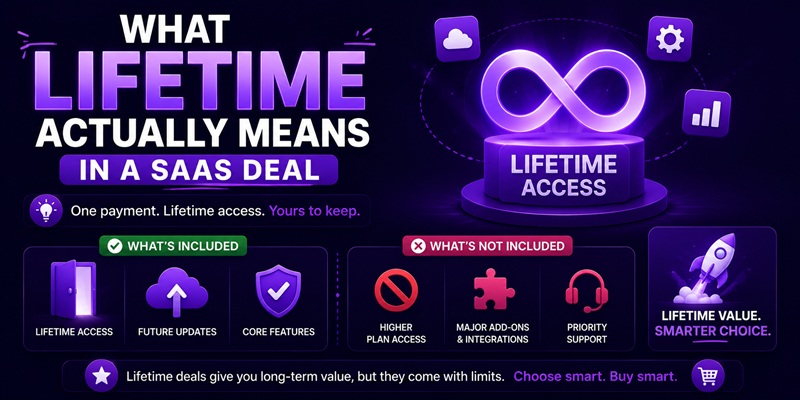
Lifetime means the product’s lifetime, not yours. When a company sells a “lifetime deal,” it is committing to keep your access working for as long as the product itself exists and the company behind it remains solvent, not for as long as you personally are alive. If the company shuts the product down, gets acquired and sunsets it, or simply stops operating, your “lifetime” access ends on that day, regardless of how many decades you had left to use it. That single distinction is the whole reason company survival matters more in this purchase than in almost any other software decision you make.
What AppSumo’s own terms actually commit vendors to
You don’t have to guess at this, because AppSumo publishes it. Under its Partner Terms, a vendor who lists a Lifetime Deal is committing to “continued access… under their Deal Terms for as long as the tool is solvent.” Read that phrase carefully: the obligation is bounded by solvency. It is not an open-ended promise. It’s a commitment that lasts exactly as long as the business does, and no marketplace can force a bankrupt or dissolved company to keep serving your account.
This is not a loophole buried in fine print, it is the plain, published meaning of the word on the platform itself. A vendor that goes out of business has not broken the deal in any legal sense; the deal was always scoped to the vendor’s own continued existence.
The three ways “lifetime” quietly ends anyway
Even when a company survives, “lifetime” access can end or shrink through paths that don’t look like a shutdown from the outside.
The company is acquired and the product is sunset. Acquisitions happen constantly in software, and an acquirer has no obligation to honor a lifetime deal it did not sell. The product can be folded into another platform, rebranded, or discontinued outright, and your lifetime access ends with whichever of those the acquirer chooses.
The vendor quietly redefines what “lifetime” means in its own terms. This is the version almost nobody checks for. A vendor can write “lifetime” into its marketing while defining a specific term length in the actual Deal Terms or Terms of Service, and that legal document, not the headline word, is what binds you. As one industry example illustrates the pattern (a case involving a VPN product, unrelated to the SEO/marketing tools this site covers), a vendor capped what it called a “lifetime” plan at a fixed number of years in its own terms. Whether any specific tool you’re considering does this is something only that tool’s own Deal Terms can answer, which is exactly why you read them before buying rather than after.
Grandfathering shrinks the plan without ending it. Your access can technically continue “for life” while the product itself changes underneath you: a feature you bought moves to a new paid tier, an integration is deprecated, or usage limits tighten. Nothing shuts down, but the thing you actually paid for narrows. This is common enough in the lifetime-deal space that it gets its own separate treatment; if a tool you own is going through this right now, the practical side of what’s allowed and what to do about it is a distinct question from the “what does lifetime mean” one this article answers.
Where to check a deal’s terms for a redefined lifetime
Before you buy, this is a two-minute check, not a legal review.
- Find the Deal Terms section on the specific listing, not the general marketing copy above it. This is where a vendor states any limits on duration, feature scope, or update commitments.
- Search the page for the word “term” or “years” in addition to “lifetime.” A redefinition, if one exists, is usually a specific number somewhere in this section, not a dramatic disclaimer.
- Check whether the vendor has done this before, by searching the product name alongside “changed terms” or reading the deal’s own comment thread, where buyers tend to flag this loudly if it happens.
- Confirm the platform’s own commitment language applies, since AppSumo’s Partner Terms bind vendors on that specific marketplace; a deal sold directly on a vendor’s own site outside a marketplace carries none of that backstop.
What this means for how you should treat the purchase
Once you accept that “lifetime” is scoped to the product’s life, not yours, the entire purchase decision changes shape. You are not buying permanence. You are buying a bet that a specific company stays in business, keeps the product running roughly as sold, and doesn’t quietly narrow what you paid for. That reframing is why the survival questions belong at the front of any evaluation, not as an afterthought after the price looks good. The lifetime deal framework walks through exactly those survival questions in order, and the red flags checklist lists the specific signs a company is close to the end of that “lifetime.” If you’re also weighing the deal against what a subscription would cost you over the same stretch, the break-even math is the companion piece for that half of the decision.
FAQ
Does “lifetime” in a SaaS deal mean forever?
No. It means for the life of the product and the company behind it, not for your personal lifetime. If the company shuts down or the product is discontinued, your access ends regardless of how long you expected to use it.
What happens to my lifetime deal if the company is acquired?
The acquirer is under no obligation to honor a lifetime deal it didn’t sell. The product may continue as-is, get folded into another platform, or be discontinued, and your access follows whatever the acquirer decides.
Can a company change what “lifetime” means after I’ve already bought?
The Deal Terms in effect at the time of your purchase are generally what govern your access, which is exactly why reading them before you buy matters. A vendor changing the definition going forward for new buyers is a different question from retroactively changing existing customers’ terms, and that specific scenario is rare enough that it belongs in a due-diligence check, not an assumption either way.
Is AppSumo’s Partner Terms commitment legally binding on the vendor?
It’s a commitment vendors accept to list a Lifetime Deal on the platform, and it’s stated plainly in AppSumo’s own help documentation. It does not create an obligation that survives the vendor going out of business entirely; a solvency requirement is built into the wording.
How do I find out if a specific tool has redefined its “lifetime” terms?
Read the Deal Terms section of the current listing for any duration language, and check the product’s own deal comment thread and recent reviews, where existing buyers tend to report this loudly if it has happened.
